ERP vs CRM: What's the Difference and Which One Do You Need?
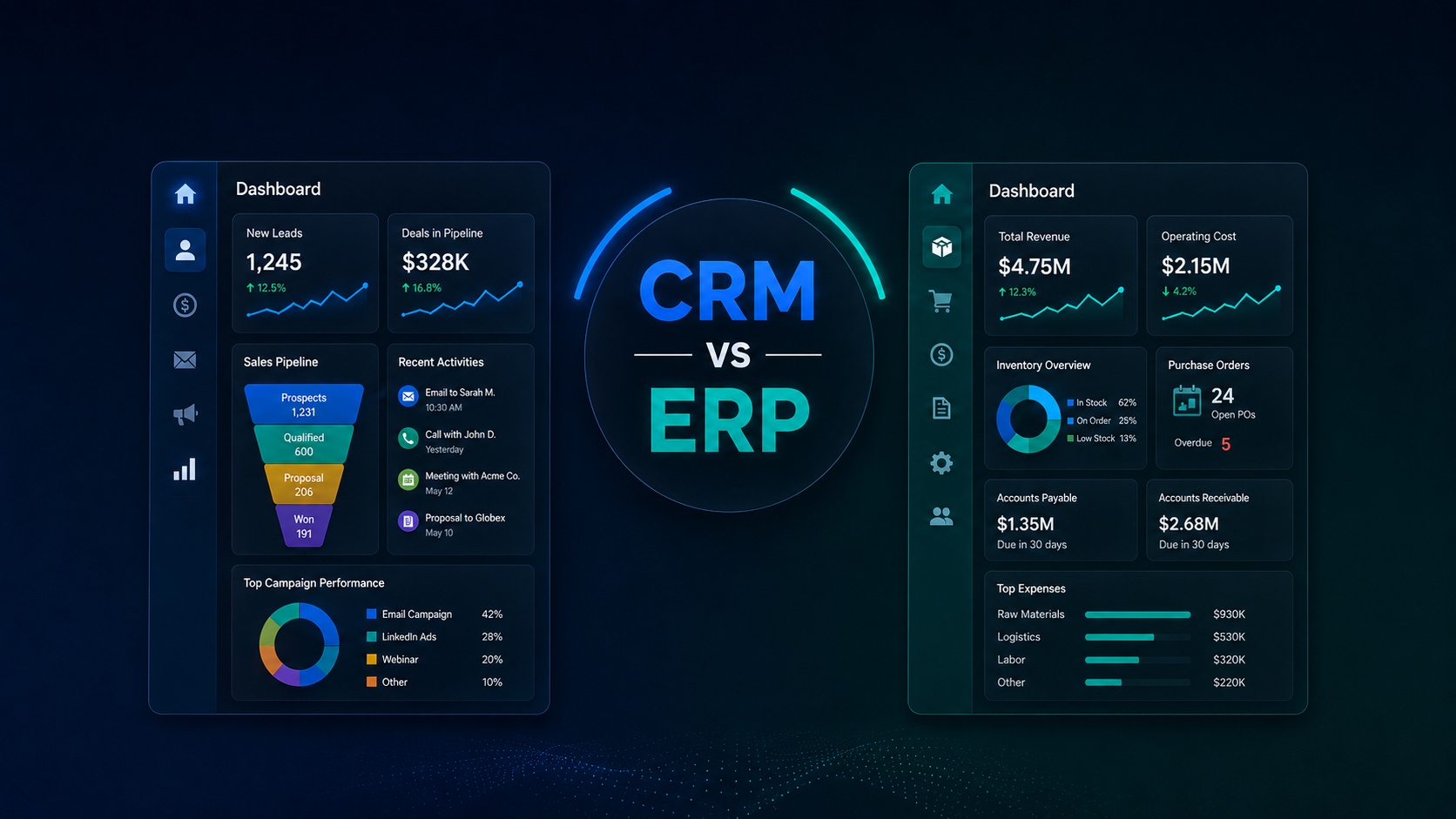
If you run a business, you've probably heard both terms thrown around — sometimes as if they're interchangeable. They're not. CRM (Customer Relationship Management) and ERP (Enterprise Resource Planning) are two different tools that solve two different problems. CRM helps you handle the people who buy from you. ERP helps you run the machine behind the scenes that makes the selling possible.
Think of a restaurant. CRM is the dining room — the host, the waiter, the menu, the experience. ERP is the kitchen, the supply room, and the accountant's desk. Both matter. Neither replaces the other.
Key Differences Between CRM and ERP
The simplest way to put it: CRM is front-office, ERP is back-office. CRM lives where your business meets the customer. ERP lives where your business runs itself.
Here's how they compare side by side:
| Feature | CRM | ERP |
| Primary Focus | Customer acquisition, retention, and satisfaction | Operational efficiency and cost control |
| Core Functions | Lead tracking, sales forecasting, marketing campaigns, customer service | Accounting, inventory, payroll, procurement, supply chain, HR |
| Typical Users | Sales reps, marketers, customer service staff | Accounting, operations, supply chain teams, executives |
| Data Handled | Contact details, purchase history, communication records, client info | General ledgers, invoices, inventory levels, payroll, vendor data |
| How It Drives Profit | Increases revenue by growing the customer base and boosting sales volume | Increases margins by cutting operational and overhead costs |
| Scope | External — interactions with customers and prospects | Internal — cross-department business operations |
One more thing worth noting: many ERP systems include CRM features built in, but CRM systems don't include ERP features. A CRM can pull invoice data through an integration, but it can't handle the transactional and financial side itself. The relationship isn't equal.
Similarities in CRM and ERP
They do share common ground, which is part of why people confuse them.
Both store and analyze data in a central database, which means your team isn't hunting through spreadsheets and email threads to find what they need. Both are usually delivered as SaaS, so you access them through the cloud without managing servers yourself. Both automate repetitive work, save time on reporting, and produce more accurate numbers than manual processes ever will. And both make your operation more secure than scattering data across different tools and inboxes.
At the highest level, they share the same purpose: improve how your company performs. They just attack the problem from opposite ends.
Which One Do You Need According to Your Tasks
This depends entirely on where your business is hurting.
If your problem is growth — you need more leads, better follow-up, sharper marketing, or a clearer picture of your customers — start with a CRM. It's the right tool when revenue generation is the bottleneck.
If your problem is operations — inventory is a mess, financials take forever to close, procurement is slow, or you can't tell what's in stock — you need an ERP. It's the right tool when the cost and complexity of running the business is the bottleneck.
Here's a quick way to decide:
| Your Situation | What You Need |
| Losing track of leads and customer conversations | CRM |
| Sales team has no visibility into pipeline | CRM |
| Marketing campaigns aren't tied to results | CRM |
| Inventory counts don't match reality | ERP |
| Month-end financial close takes too long | ERP |
| Payroll, HR, and accounting live in separate systems | ERP |
| You're scaling and hitting walls on both fronts | Both, integrated |
Most growing companies eventually need both. The common path is to start with whichever solves the more urgent problem, then integrate the second one later so customer data in the CRM syncs with invoicing and fulfillment in the ERP. That gives you one connected view of the business — from the first time a prospect hears about you to the final invoice paid.
The wrong move is forcing one tool to do the other's job. A CRM won't run your supply chain. An ERP won't build you better customer relationships. Pick based on the work, not the marketing.
Ready to estimate your app cost?
Use our free calculator to get a personalised cost breakdown in 2 minutes.
Calculate Your App Cost